What the neighbors think of our elections


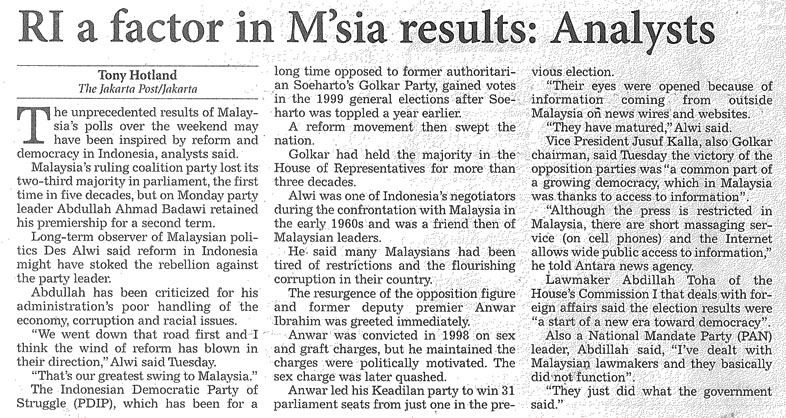
The Opposition in Malaysia did so well in Saturday’s polls because they were inspired by reform and democracy in Indonesia, so claims “analysts” in a Jakarta Post front page story today.
ri-factor.jpg

The story needs some unspinning and should not be given too much credence. The “analysts” referred to in the headline is actually one person, Des Alwi, who at best may be classified as an observer. Not sure whether he knows what he’s talking about when it comes to Malaysia today although he’s probably an authority if malaysia in the Tengku’s days.  The other reasons given by other observers attribute it to greater access of information from the internet (that’s you bloggers, so take a bow).

The quote that takes the cake is in the last two paragraphs of the story:

Also, a national mandate Party leader, Abdillah said, “I’ve dealt with malaysian lawmakers and they basically did not function.”

“They just did what the government aid.” 

Aiyoh! So malu to have the neighbors tut tuting at our Malaysia Boleh lawmakers.

2 responses to “What the neighbors think of our elections”

  1. There’s a hypothesis called ‘contagion effect’. It can by simply defined as ‘what happens in a country might affect changes in the region or another country with similar condition’. So, what happens in Indonesia might have impacts to the current changes in Malaysia, directly or indirectly. Yet, I agree that it needs further and deeper analyses before coming to conclusion about it.

    However, I do believe that there’s a connection between democratisation processes in Indonesia and Malaysia. For example, pro-democracy activists of the two countries have met since, at least, a decade ago to share experiences and talk about regional cooperation between social movements in Malaysia, Indonesia and other Southeast Asian countries.

    I was also involved in establishing a youth network called Young Progressives Southeast Asia (YPSEA, link: http://ypsea.blogspot.com/), which includes the DAPSY (DAP’s youth organisation) and DEMA (a Malaysian student organisation). So, in that respect, the sharing of experiences can have, more or less, impacts on the methods that the Malaysian pro-democracy movements implement in the country.

    Anyway, thanks for the lunch today! I’ve written about it in my blog. 🙂 Keep in touch!

    Like

  2. how about in Singapore context? would Singaporeans be affected by Indonesian style of democratic elections?

    Like

Leave a comment